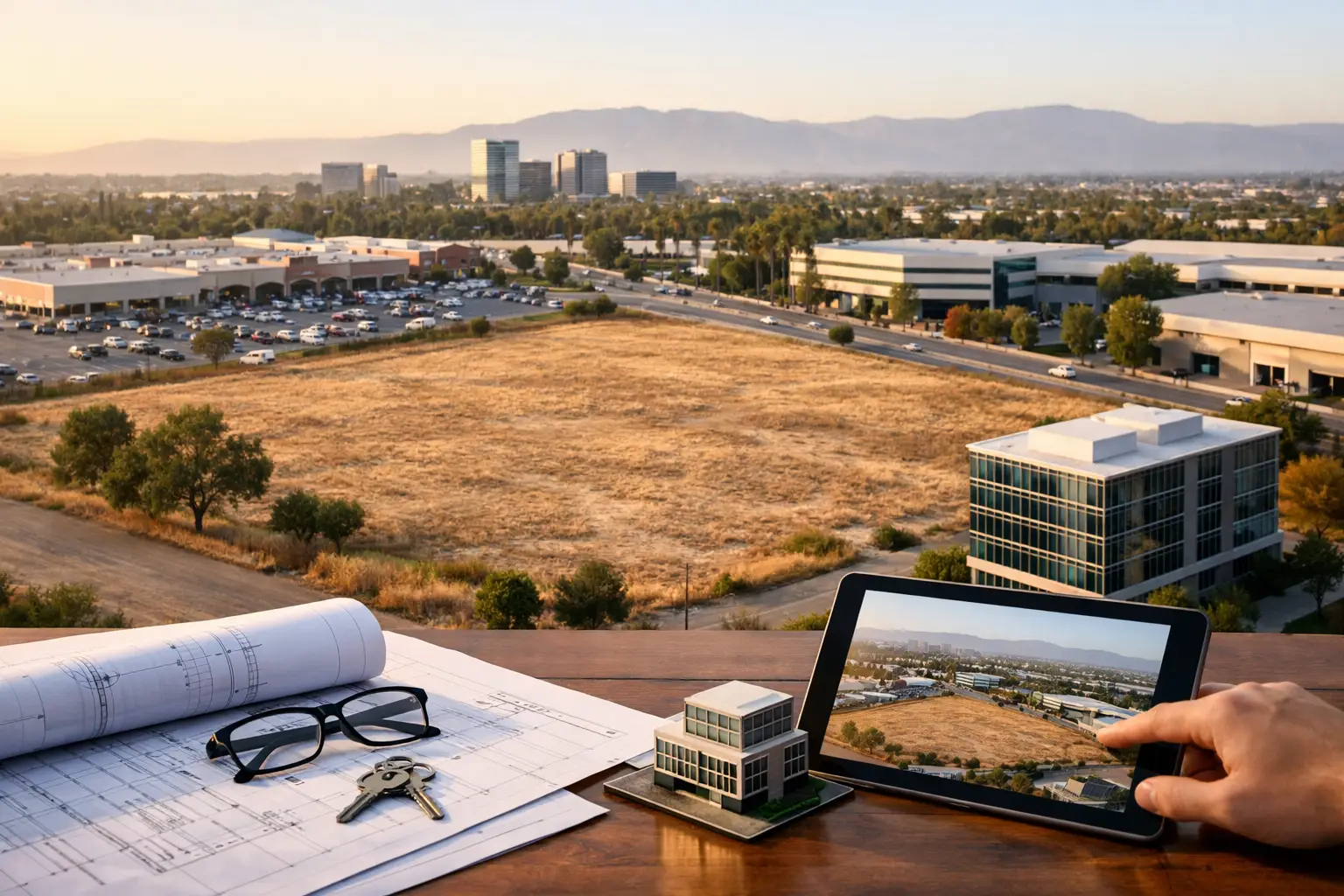
A commercial parcel can look simple from the street - just dirt, frontage, and a sign. But in commercial land sales, value is rarely about what the site is today. It is about what can be built, what can be entitled, how quickly a buyer can move, and whether the numbers still work after all the hidden costs show up.
That is why sellers, investors, and landowners across California need a different playbook for land than they do for an income property or a residential listing. Commercial land does not sell on granite countertops or staged interiors. It sells on use case, timing, access, and confidence. When the marketing and underwriting are sharp, the right buyer sees opportunity. When they are not, a site can sit for months while the market moves on.
What drives commercial land sales
The strongest commercial land sales start with a clear answer to one question: who is the most likely buyer for this site? In some cases, it is a developer pursuing retail, multifamily, industrial, or medical use. In others, it is an owner-user looking for a future headquarters, yard, warehouse, or service business location. Occasionally, the best buyer is a neighboring owner who values assemblage more than anyone else in the market.
Each buyer type sees land differently. A developer cares about density, setbacks, parking ratios, utility availability, and approval timelines. An owner-user may care more about visibility, truck access, and whether construction costs still pencil out. An investor may be willing to land-bank a site, but only if the long-term upside justifies the carry.
That is where pricing often gets distorted. Sellers naturally compare their parcel to the highest sale in the area. Buyers, especially experienced ones, underwrite from risk backward. If entitlement uncertainty is high, environmental questions are open, or site work will be expensive, pricing pressure follows fast. The land may still be attractive, but only at a number that leaves room for those unknowns.
Pricing commercial land sales the right way
Pricing commercial land is more analytical than many owners expect. There may be very few truly comparable sales, and even nearby parcels can have very different values based on zoning, topography, lot shape, frontage, access, and development constraints.
A credible pricing strategy usually blends several lenses. Comparable land sales matter, but they should be adjusted with discipline. Residual land value can also matter, especially for development sites, because sophisticated buyers will test the future project economics before they ever make an offer. If construction costs are high, financing is tight, or lease rates in the submarket are soft, land value can compress even when the surrounding area looks strong.
This is especially true in California, where entitlement time, permit costs, utility work, and local jurisdiction requirements can materially change what a buyer is willing to pay. A parcel in a high-demand corridor may still trade below owner expectations if the path to vertical development is slow or expensive. On the other hand, a site with clean zoning, strong frontage, and a realistic development path can draw competition quickly.
Why zoning and entitlements shape buyer demand
In commercial land sales, zoning is not a detail. It is the framework for value. Buyers want to know what is allowed by right, what requires discretionary approval, what development standards apply, and what political or neighborhood resistance could appear during the process.
A parcel marketed simply as commercial land leaves too much unanswered. Is it suited for retail, office, mixed use, hospitality, automotive, or industrial use? Are there height limits, floor area restrictions, parking burdens, or design review hurdles? Can utilities support the intended use without major off-site improvements? The more clarity a seller can provide, the more serious buyer interest tends to become.
This does not mean every seller needs a full entitlement package before listing. Sometimes that is not cost-effective. But it does mean the positioning should be informed. If there is a likely highest and best use, the market should see it clearly. If there are constraints, they should be framed honestly and early. Serious buyers usually find issues during due diligence anyway. Strong positioning builds trust instead of creating friction later.
Marketing commercial land sales beyond the listing sheet
Land marketing needs more than a sign and a basic listing upload. Buyers are making a future-looking decision, so the marketing has to help them visualize possibility while staying grounded in facts.
A strong campaign usually starts with clean presentation. That includes aerials, parcel maps, zoning context, traffic exposure, utility notes, access points, surrounding tenant mix, and a direct explanation of the site's likely use cases. The best land marketing does not oversell. It reduces guesswork.
Digital reach matters too. Many investors and developers first encounter opportunities online, and attention is limited. A property package that translates complex information into a fast, readable story has an edge. That is particularly relevant in Southern California, where buyer pools can be local, regional, national, and international at the same time. Multilingual communication can also be a real advantage, especially when buyers or capital sources are more comfortable evaluating opportunities in Chinese as well as English.
At Aspire La Shine, this is where modern promotion matters. Exposure across traditional brokerage channels is still essential, but so is market-facing digital content that puts the opportunity in front of the right audience quickly. Commercial land is often a niche product, and niche products need targeted visibility.
What sellers should prepare before going to market
Owners often lose momentum when a buyer asks for basic information that is not ready. In commercial land sales, preparation sends a signal. It tells buyers the transaction will be managed professionally.
At minimum, sellers should be ready to provide parcel details, title information, zoning designation, APN data, any known reports or studies, utility availability, access information, tax data, and a clear ownership structure. If surveys, environmental materials, concept plans, or municipal correspondence exist, those can be valuable. Even when documentation is incomplete, knowing what is available and what is not helps keep negotiations efficient.
There is a trade-off here. Spending heavily on reports before a sale is not always the right move, particularly if the likely buyer will conduct its own studies anyway. But going to market with no organized information at all can weaken pricing and stretch the timeline. The right balance depends on the asset, the target buyer, and the competitiveness of the submarket.
Buyer behavior in today’s California market
Commercial land buyers are still active, but they are selective. They are asking harder questions about financing, entitlement risk, construction timing, and exit assumptions. That does not mean land is weak. It means the margin for vague pricing and thin marketing is smaller.
In stronger infill locations, well-positioned sites can still move well, especially if they match real demand from users or developers. In more speculative situations, buyers may seek discounts to compensate for time and uncertainty. That gap between seller expectation and buyer underwriting is where many deals stall.
This is also why negotiation strategy matters. A higher price with a short due diligence window and hard deposit may be stronger than a slightly higher headline offer loaded with contingencies. Terms, certainty, and buyer credibility matter in land transactions more than many first-time sellers realize.
Common mistakes that slow commercial land sales
The first mistake is assuming every commercial parcel has immediate development appeal. Some do. Some need patience, repositioning, or a more specialized buyer. The second is overpricing based on residential logic or on nearby listings rather than closed land transactions and realistic use assumptions.
Another common issue is incomplete positioning. If the marketing does not explain why the site matters, buyers will either move on or discount aggressively. And finally, many sellers underestimate how much responsiveness affects deal flow. Serious land buyers often look at multiple opportunities at once. Slow answers can quietly kill momentum.
A smarter way to approach the opportunity
Commercial land sales reward preparation, market fluency, and disciplined storytelling. The land itself may be fixed, but the outcome is not. Price, positioning, documentation, and buyer targeting all shape whether a site attracts curiosity or real offers.
If you own commercial land in California, the goal is not just to put it on the market. The goal is to present it in a way that makes a buyer feel the path forward is visible, practical, and worth pursuing. When that happens, the property stops being just a parcel and starts becoming a project someone wants to win.
The right deal often begins when the site is framed with precision, not hype - and when the seller is ready to meet the market as it actually is.